PROPOSAL OF SERVICE
The siege engines come first
A proposal of service, undated, priced in Milanese lire. What survives is the draft, not the answer.
To: a patron with a border and a budget
I
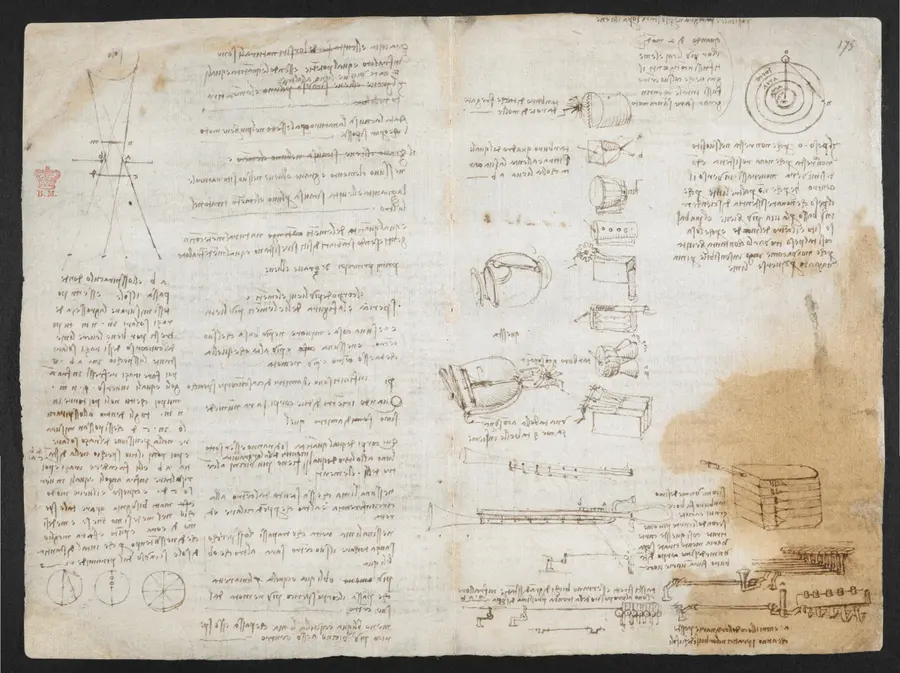
A draft survives in which a man offers portable bridges, the draining of ditches, the undermining of walls not founded on rock, cannon of forms not in common use, and an indefinite number of further engines. Architecture, sculpture and painting appear once, at the end, in a single line.
II
The draft carries no date, and it is given one constantly. Nothing records its dispatch and nothing records an answer. What survives is a sheet of paper with an order of priorities on it, which is the only thing it can honestly be read for.
III
The one instrument with figures on it runs the other way. Eight hundred Milanese lire for an altarpiece, materials included, 25 April 1483. One hundred paid up front. Then years of petitioning for the remainder, and no record of how the petitioning ended.
IV
Materials included is the clause that does the work. It means the fee and the cost of executing it come out of the same purse, so the panel, the ultramarine and the assistant who grinds it are all paid for by the man being paid.
V
In 1498 he was granted a vineyard: a notarial deed in October, a ducal confirmation the following April. Payment in land rather than coin, which at least required a notary, and a notary keeps a copy.
VI
Determination: the capability was real and the ordering was the career. Paragraphs of ordnance, one line of painting, and a fee that had already bought its own pigment. Most of what is repeated about this document — its date, its dispatch, its success, the position of the art in it — is not in the document.
Support this work
Support links leave this site and are handled entirely by the processor; payment details never reach freshcod3s.
Freshcod3s LLC is an independent company, not a nonprofit. Support is business income and is not tax-deductible.